
You've optimized your website perfectly. Your content is excellent, your title tags are spot-on, and your pages load fast. You hit publish and wait for the traffic to come flooding in. But weeks pass, and you're still invisible in search results.
What's missing?
Here's the truth: creating great content and optimizing your pages isn't enough. Google doesn't just look at what you say about yourself—it looks at what others say about you. That's where off-page SEO comes in.
So, what is off-page SEO? Off-page SEO refers to all actions taken outside your own website to improve its authority, trust, and visibility in search engines. It's about building your reputation across the internet so search engines see you as credible and worth ranking higher.
Think of it this way: on-page SEO is you telling Google you're awesome. Off-page SEO is everyone else telling Google you're awesome. And guess which one Google trusts more?
In this guide, I'll walk you through everything you need to know about off-page SEO—what it includes, why it matters, and exactly how to start building your website's authority today. If you've mastered on-page optimization but your rankings are still stuck, this is the missing piece you need.
Let's dive in and build your reputation.
What Is Off-Page SEO? (The Clear Definition)
Let me break down off-page SEO in a way that really makes sense.
The simple definition: Off-page SEO (also called off-site SEO) includes all the strategies and actions that happen away from your website to boost your search rankings. While on-page SEO is what you do on your site, off-page SEO is what you do everywhere else on the internet to build credibility and authority.
Here's a powerful analogy: Think of your website as a person's reputation. On-page SEO is how you present yourself—your appearance, your resume, what you say about yourself. But off-page SEO is what other people say about you—their recommendations, reviews, and whether they trust you enough to vouch for you.
Just like in real life, what others say about you carries more weight than what you say about yourself.
What Off-Page SEO Includes
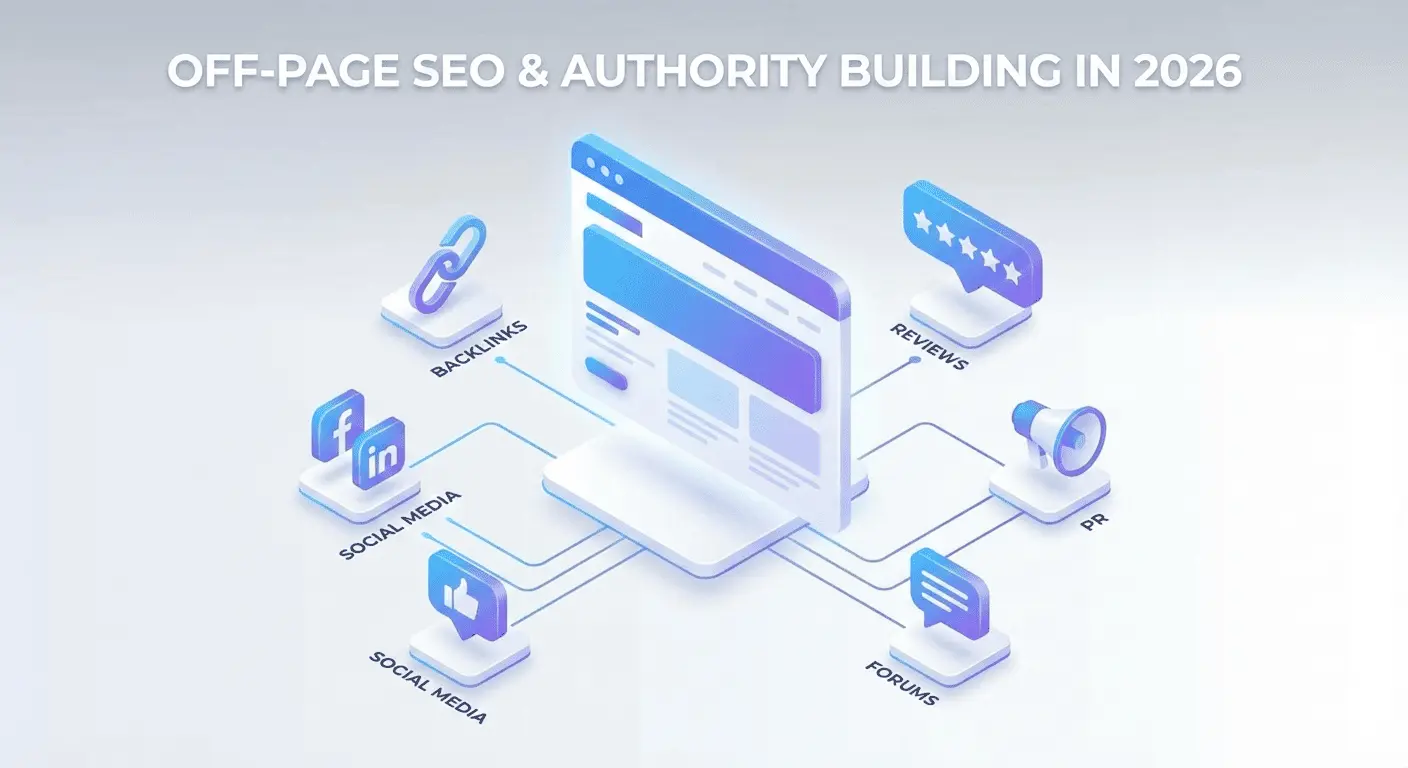
Off-page optimization covers several key activities:
- Link building: Earning backlinks from other websites (the most important factor)
- Brand mentions and citations: When other sites mention your brand, even without linking
- Social media engagement: Building visibility and sharing your content across platforms
- Reviews and reputation management: What customers say about you online
- Guest blogging and collaborations: Contributing content to other sites in your niche
- Influencer partnerships: Working with respected voices in your industry
- Digital PR: Getting featured in publications and media outlets
- Community participation: Being active in forums, Q&A sites, and online communities
What It's NOT
Let's clear up some confusion. Off-page SEO is NOT:
- Optimizing title tags or meta descriptions (that's on-page SEO)
- Fixing site speed or mobile-friendliness (that's technical SEO)
- About quick tricks or shortcuts (it's about sustained credibility)
- Something you can fully control (you're relying on others to validate you)
Why This Matters
Search engines face a big challenge: anyone can claim to be an expert or authority on their own website. How do they separate genuine experts from pretenders?
They look at off-page signals.
Backlinks from respected websites, brand mentions across the web, positive reviews, social engagement—these are all votes of confidence from the wider internet. They tell search engines, "This site is legitimate, trustworthy, and worth showing to searchers."
A well-respected website with strong off-page SEO will consistently outrank an unknown one, even if both have similar on-page optimization and content quality. That's the power of reputation.
Off-Page SEO vs. On-Page SEO vs. Technical SEO
Before we go deeper, let's make sure you understand how off-page SEO fits into the complete SEO picture. There are three main types, and they work together like a well-oiled machine.
Here's how they compare:
On-Page SEO (On-Site SEO):
- Focus: Everything on your website
- Examples: Title tags, content quality, headers, images, internal links
- Control level: Full control—you decide everything
- Goal: Optimize content for users and search engines
Off-Page SEO (Off-Site SEO):
- Focus: Everything outside your website
- Examples: Backlinks, social sharing, brand mentions, reviews, guest posts
- Control level: Partial control—you can encourage but not force
- Goal: Build authority, trust, and reputation
- Focus: Behind-the-scenes website optimization
- Examples: Page speed, mobile-friendliness, indexing, site structure, security
- Control level: Full control—technical implementation
- Goal: Ensure search engines can access and understand your site
The Easy Way to Remember This
Think of SEO as a three-legged stool. You need all three legs for it to stand strong:
- On-page SEO = Your content (what you say)
- Technical SEO = Your foundation (how your site works)
- Off-page SEO = Your reputation (what others say about you)
Remove any leg, and the stool topples over. Master all three, and you've built something solid that can support real growth.
This article focuses specifically on off-page SEO—the trust and authority leg. If you haven't optimized your on-page elements yet, I'd recommend starting there first. But if your on-page SEO is already solid and you're ready to build your reputation, you're in the right place.
Why Off-Page SEO Matters
Let me make this crystal clear: off-page SEO isn't optional if you want to rank competitively. Here's why it matters for everyone involved.
For Search Engines
Search engines use off-page signals to:
- Determine which websites are credible and trustworthy enough to rank highly
- Assess your authority in your specific niche or industry
- Gauge how popular and valuable your content is based on how others reference it
- Identify patterns of genuine recommendation versus manipulative tactics
Backlinks remain one of Google's strongest ranking factors. Multiple studies consistently show that pages with more high-quality backlinks rank higher than those without them.
For Your Business or Website
Off-page SEO creates tangible business benefits:
- Long-term brand trust: When people see your name mentioned across reputable sites, they trust you more
- Increased organic traffic: Higher rankings mean more visitors discovering your content
- Referral traffic: Quality backlinks don't just help SEO—they send actual visitors to your site
- Better conversion rates: People who recognize your brand from multiple sources are more likely to convert
- Competitive advantage: Strong authority is hard for competitors to replicate quickly
For Your Users
When you have strong off-page SEO, users benefit:
- They discover you through trusted sources they already follow
- Your visibility in search results implies you're an authority worth their time
- They can verify your credibility through mentions and reviews on other sites
- They're more likely to trust your recommendations and content
The Reality Check
Here's what you need to know: off-page SEO takes time. You can optimize your title tags in an afternoon, but building genuine authority takes months or even years of consistent effort.
But here's the good news: once you've built that authority, it compounds. Each backlink makes the next one easier to earn. Each mention increases your visibility and makes future mentions more likely. It's a marathon, not a sprint—but it's absolutely worth running.
Essential Off-Page SEO Elements Explained
Now that you understand what off-page SEO is, let's break down the most important elements you'll focus on. I'll explain each one clearly and show you exactly how to approach them.
1. Link Building (Backlinks)
This is the cornerstone of off-page SEO, so we'll spend the most time here.
What backlinks are: A backlink is simply a link from another website pointing to yours. When Website A links to Website B, that's a backlink for Website B.
Why they matter: Each quality backlink acts like a vote of confidence. It tells search engines, "This content is valuable enough that I'm recommending it to my audience." The more quality votes you have, the more authority you build.
But not all backlinks are equal. A link from a respected industry publication carries far more weight than a link from a random, low-quality directory.
What makes a backlink valuable:
- Relevance: Links from sites in your niche or industry matter most
- Authority: Links from well-established, trusted sites carry more weight
- Placement: Links in the main content are more valuable than footer links
- Anchor text: The clickable text should be natural and descriptive (but not over-optimized)
- Follow vs. nofollow: "Follow" links pass authority; "nofollow" links don't (but can still bring traffic)
How to build quality backlinks:
Create Link-Worthy Content: The foundation of any link-building strategy is content so good that people naturally want to reference it. This includes:
- Original research and data
- Comprehensive guides and tutorials
- Unique tools or calculators
- Infographics and visual resources
- Expert roundups and interviews
Guest Blogging: Write valuable articles for other websites in your niche. You typically get a backlink in your author bio or within the content. The key is to pitch genuinely helpful content, not thinly-veiled self-promotion.
Broken Link Building: Find broken links on other websites (links that lead to 404 errors), then reach out and suggest your relevant content as a replacement. This helps the site owner fix their site while earning you a backlink.
Digital PR: Get featured in online publications, news sites, or industry blogs. This requires pitching newsworthy angles, original research, or expert commentary on trending topics.
Resource Page Link Building: Many sites maintain pages listing helpful resources in their industry. If your content genuinely adds value, reach out and suggest they include it.
Skyscraper Technique: Find content in your niche that has earned lots of backlinks, create something even better, then reach out to sites linking to the original and show them your improved version.
HARO (Help a Reporter Out): Journalists use this platform to find expert sources. Respond to relevant queries with helpful insights, and you might get quoted with a backlink to your site.
Common mistakes to avoid:
- Buying links: This violates Google's guidelines and can result in penalties
- Pursuing quantity over quality: 10 links from authoritative sites beat 1,000 links from spam directories
- Ignoring relevance: Links from completely unrelated sites look unnatural
- Over-optimized anchor text: Using exact-match keywords repeatedly looks manipulative
- Link schemes: Networks designed solely for link exchange will get you penalized
2. Brand Mentions and Citations
Not all references to your brand include a link, but they still matter.
What they are: Any time someone mentions your brand name, business name, or even your domain without creating a clickable link.
Why they matter: Search engines are increasingly sophisticated at connecting unlinked mentions to your brand. These mentions build brand awareness and can serve as trust signals even without direct links.
How to encourage mentions:
- Create newsworthy content or campaigns that people naturally talk about
- Engage with journalists and bloggers in your industry
- Participate actively in your niche community
- Monitor brand mentions with tools like Google Alerts
- When you find unlinked mentions, politely reach out and ask if they'd consider making it a link
Local citations: For local businesses, citations (your name, address, phone number) on directories like Yelp, Yellow Pages, and industry-specific directories are crucial. Make sure this NAP information is consistent everywhere it appears.
3. Social Media Engagement
Let me be clear upfront: social media signals aren't direct ranking factors. Google doesn't count your likes and shares as backlinks.
But social media still matters for off-page SEO. Here's why:
How social media helps:
- Content amplification: Your content reaches more people, increasing the chance someone will link to it
- Referral traffic: Direct visitors from social platforms
- Brand visibility: More people discover and remember your brand
- Relationship building: Connect with influencers, journalists, and potential link partners
- Trending signals: Viral content can attract media attention and natural backlinks
What to do:
- Share your content on platforms where your audience actually hangs out
- Engage genuinely—comment, respond, participate in conversations
- Build relationships before asking for anything
- Use social listening to find opportunities for engagement
- Don't just broadcast—be social
Remember: social media is about being human and building community, not just promoting links.
4. Content Promotion and Outreach
Creating great content isn't enough—you need to actively promote it.
What this involves: Strategically reaching out to people who might find your content valuable and getting it in front of the right audiences.
How to do it effectively:
Email Outreach:
- Identify websites and influencers in your niche
- Personalize your emails (no mass templates)
- Explain why your content would benefit their audience
- Make it easy for them to share or link (no demands)
- Follow up once if you don't hear back
Influencer Collaboration:
- Partner with respected voices in your industry
- Offer value first (interview them, feature their work)
- Co-create content together
- Build genuine relationships, not transactional link exchanges
Content Syndication:
- Republish your content on platforms like Medium, LinkedIn, or industry sites
- Use canonical tags to indicate the original source
- Reach new audiences while maintaining SEO value
Key principle: Focus on building relationships, not just acquiring links. The sites most worth getting backlinks from are the ones least likely to respond to cold link requests. Invest in genuine connections.
5. Local SEO and Reviews
If you're a local business or serve specific geographic areas, local SEO is crucial.
What it includes:
- Google Business Profile optimization (formerly Google My Business)
- Customer reviews on Google, Yelp, Facebook, and industry-specific sites
- Local directory listings and citations
- Location-specific content
- Local backlinks from community organizations, local media, etc.
Why reviews matter:
- They build trust with potential customers
- They influence local pack rankings
- They provide fresh, user-generated content
- They show engagement and legitimacy
How to improve local off-page SEO:
- Claim and optimize your Google Business Profile
- Actively request reviews from satisfied customers (make it easy)
- Respond to all reviews, positive and negative
- Ensure NAP consistency across all directories
- Get involved in local community events and earn mentions
- Partner with other local businesses
6. Online PR and Authority Building
This is about positioning yourself or your brand as a trusted voice in your industry.
What it looks like:
- Being quoted in major publications
- Appearing as a guest on podcasts
- Speaking at webinars or virtual events
- Contributing expert commentary to news articles
- Participating in industry roundups
Why it matters: These placements typically come with backlinks from high-authority domains. More importantly, they position you as an expert and increase brand recognition.
How to get started:
- Use HARO to respond to journalist queries
- Pitch original data or research to journalists
- Offer expert commentary on trending topics in your industry
- Create a media kit making it easy for others to feature you
- Build relationships with journalists and publications in your niche
- Start with smaller publications and work your way up
7. Forums, Communities, and Q&A Sites
Strategic participation in online communities can build visibility and authority.
Where to participate:
- Reddit (in relevant subreddits)
- Quora (answering questions in your expertise area)
- Industry-specific forums
- Facebook groups
- LinkedIn groups
- Niche community sites
How to do it right:
- Provide genuinely helpful answers and insights
- Build your reputation before ever dropping a link
- Link only when it truly adds value to the conversation
- Focus on being helpful, not promotional
- Engage consistently over time
What not to do:
- Drop links without context or value
- Spam multiple communities with the same promotional content
- Join just to promote yourself
- Ignore community rules
Done right, community participation builds authentic authority. Done wrong, it damages your reputation.
8. Influencer Marketing
Partnering with influencers can amplify your reach and earn valuable backlinks.
What it involves: Collaborating with people who have established audiences in your niche to promote your content, product, or brand.
Types of influencer partnerships:
- Sponsored content or reviews
- Product collaborations
- Co-created content
- Guest appearances on their platforms
- Affiliate partnerships
How to approach it:
- Choose influencers whose audience aligns with yours
- Focus on engagement rate, not just follower count
- Build a relationship before pitching collaboration
- Offer clear value for both their audience and them
- Track results to measure ROI
Benefits beyond backlinks:
- Reach new audiences
- Build brand credibility through association
- Generate social proof
- Drive direct traffic and conversions
9. Podcasts, Webinars, and Collaborations
Appearing on podcasts or hosting webinars creates backlink opportunities while building authority.
Why this works:
- Podcast show notes typically include links to guests' websites
- Webinars often get shared and linked to by participants
- You reach engaged audiences who might become advocates
- You build relationships with hosts who might link to you later
How to get started:
- Search for podcasts in your niche
- Pitch yourself as a guest with specific, valuable topic ideas
- Prepare thoroughly to provide real value
- Promote the episode/webinar to your audience too
- Follow up and maintain the relationship
10. Content Syndication
Republishing your content on third-party platforms can extend your reach.
Where to syndicate:
- Medium
- LinkedIn articles
- Industry-specific platforms
- Partner websites
How to do it safely:
- Use canonical tags pointing to your original content
- Publish on your site first, then syndicate
- Include attribution and links back to the original
- Choose platforms with genuine audiences, not content farms
Benefits:
- Reach new audiences
- Build brand awareness
- Potential for additional backlinks
- Establish thought leadership across platforms
How to Do Off-Page SEO (Step-by-Step Process)
Now let's put everything together into a clear, actionable workflow you can follow.
Step 1: Research Your Niche and Identify Authority Sites
Start by understanding the landscape:
- Who are the respected voices and publications in your industry?
- Which websites does your target audience read and trust?
- Where are your competitors getting their backlinks from?
Use tools like Ahrefs or SEMrush to analyze competitor backlinks. Make a list of potential targets.
Step 2: Audit Your Current Backlink Profile
Before building new links, understand what you already have:
- Use Google Search Console, Ahrefs, or SEMrush to see your current backlinks
- Identify your strongest links
- Look for any toxic or spammy links you should disavow
- Understand your starting point so you can measure progress
Step 3: Create Link-Worthy Content
This is absolutely essential. Focus on creating content that naturally attracts links:
- Comprehensive guides that become go-to resources
- Original research or surveys
- Data visualizations and infographics
- Useful tools or calculators
- Controversial but well-researched opinion pieces
- Expert roundups
Ask yourself: "Would I link to this content from my own site?" If not, improve it first.
Step 4: Start Strategic Outreach
Now begin reaching out to potential link partners:
- Guest post pitches to relevant blogs
- Resource page suggestions
- Broken link building opportunities
- Digital PR pitches to journalists
- Partnership proposals to complementary businesses
Personalize every outreach email. Generic templates get ignored.
Step 5: Promote Your Content on Social Media
Don't wait for people to find your content:
- Share it across all relevant social platforms
- Tag people mentioned or quoted in the piece
- Join conversations where your content adds value
- Engage with everyone who shares or comments
Step 6: Build Relationships Before Asking for Links
The most valuable links come from genuine relationships:
- Engage with others' content regularly
- Provide value without expecting anything in return
- Comment thoughtfully on blogs and social media
- Share others' work
- Build trust over weeks and months
Then, when you do have something worth sharing, people are more receptive.
Step 7: Track Your Backlinks and Mentions
Monitor your progress consistently:
- Check Google Search Console monthly
- Set up Google Alerts for brand mentions
- Use Ahrefs or SEMrush to track new backlinks
- Monitor referral traffic in Google Analytics
- Celebrate wins and learn from what works
Step 8: Focus on Long-Term Strategy
Off-page SEO isn't about quick wins:
- Build consistent content promotion habits
- Nurture relationships continuously
- Diversify your backlink sources
- Focus on earning links, not manipulating them
- Be patient—authority builds over time
Remember: one high-quality backlink from an industry authority is worth more than dozens of low-quality links from random sites.
Common Off-Page SEO Mistakes to Avoid
Even with good intentions, it's easy to make mistakes. Here are the most common pitfalls and how to avoid them.
1. Buying Links
Some services offer to sell you backlinks. Don't do it. Google explicitly forbids this, and they're good at detecting it. Penalties can devastate your rankings.
Solution: Focus on earning links through quality content and relationships.
2. Ignoring Relevance
Getting links from high-authority sites sounds great, but if they're completely unrelated to your niche, they don't help much and can look unnatural.
Solution: Prioritize relevant links from sites in your industry, even if they have less authority than unrelated options.
3. Over-Optimizing Anchor Text
Using the exact same keyword-rich anchor text repeatedly looks manipulative.
Solution: Use varied, natural anchor text. Mix branded terms, generic phrases, and occasional keyword-rich anchors.
4. Neglecting Brand Building
Focusing solely on technical link building without building genuine brand awareness is a mistake.
Solution: Invest in content marketing, social media presence, and genuine community engagement alongside your link building efforts.
5. Ignoring Local SEO (For Local Businesses)
If you serve local customers, ignoring local citations and reviews is a huge missed opportunity.
Solution: Claim your Google Business Profile, actively gather reviews, and ensure consistent NAP information across directories.
6. Spamming Forums and Comments
Dropping your links in blog comments or forums without adding value damages your reputation and rarely helps SEO.
Solution: Participate genuinely. Add value first, link only when truly relevant, and build authentic presence in communities.
7. Focusing Only on Quantity
Chasing hundreds of low-quality links instead of a few high-quality ones wastes time and can hurt you.
Solution: Quality over quantity, always. One link from a respected industry publication beats 100 directory links.
8. Giving Up Too Soon
Off-page SEO takes time. Many people quit after a few weeks when they don't see immediate results.
Solution: Commit to consistent effort over months. Set realistic expectations and celebrate small wins along the way.
9. Ignoring Link Context
A link buried in a footer or sidebar isn't as valuable as one in the main content where it's clearly relevant.
Solution: Focus on earning contextual links within the body of content where they naturally fit.
10. Not Monitoring Your Backlink Profile
Negative SEO (competitors building spammy links to your site) is rare but real. Plus, you might earn toxic links naturally.
Solution: Regularly audit your backlink profile and disavow harmful links through Google Search Console.
Off-Page SEO Best Practices for 2026
Off-page SEO evolves as search algorithms get smarter. Here's what matters most right now.
Emphasis on E-E-A-T
Google's focus on Experience, Expertise, Authoritativeness, and Trustworthiness is stronger than ever.
- Build real expertise and demonstrate it publicly
- Get credentials and experience mentioned in author bios
- Earn features and quotes from respected publications
- Build a consistent online presence that demonstrates authority
Relationship-Driven Link Building
Transactional, one-off link requests don't work well anymore. Success comes from genuine relationships.
- Invest time in networking and community building
- Provide value before asking for anything
- Think long-term partnerships, not quick exchanges
- Focus on mutual benefit
Diversify Your Link Sources
Don't rely on just one tactic or type of backlink.
- Mix guest posts, digital PR, resource links, and collaborations
- Get links from various types of sites (media, educational, industry blogs, etc.)
- Include different content formats (articles, tools, research, visual content)
Digital PR Over Traditional Outreach
Modern link building looks more like public relations than technical SEO.
- Pitch newsworthy stories to journalists
- Create and promote original research
- Comment on trending industry topics
- Build a media-ready brand presence
Brand Building Is Essential
Google increasingly factors branded search traffic into rankings. When people search for your brand specifically, it signals authority.
- Invest in content marketing that builds brand awareness
- Create memorable, shareable campaigns
- Focus on becoming known in your niche
- Think beyond just links to overall brand presence
Monitor Link Quality Regularly
It's not just about earning links—it's about maintaining a healthy profile.
- Regularly audit your backlinks
- Disavow genuinely harmful links
- Watch for negative SEO attempts
- Maintain the quality of sites linking to you
Integrate All Three SEO Types
Off-page SEO works best when combined with strong on-page and technical SEO.
- Don't build links to poorly optimized pages
- Ensure your site provides excellent user experience
- Keep your technical foundation solid
- Think holistically about SEO, not just individual tactics
Focus on User Intent and Value
Everything comes back to providing real value:
- Create content worth linking to
- Build relationships worth maintaining
- Participate in communities authentically
- Earn reputation through genuine expertise
The sites that succeed long-term are those that stop thinking about "gaming" algorithms and start thinking about genuinely building authority and trust.
Tools for Off-Page SEO
The right tools make off-page SEO much more manageable. Here are the ones I recommend.
Free Tools
Google Search Console Essential for monitoring your backlinks directly from Google. Shows which sites link to you and can help identify issues.
Google Alerts Set up alerts for your brand name and key industry terms. Get notified when you're mentioned online, even without links.
HARO (Help a Reporter Out) Connect with journalists looking for expert sources. Free to use and can earn high-quality backlinks from major publications.
Ubersuggest (Free Version) Limited free backlink checking and competitor analysis. Good starting point for small businesses.
Google Analytics Track referral traffic from backlinks and measure the impact of your off-page efforts.
Paid Tools (Worth the Investment)
Ahrefs One of the best tools for comprehensive backlink analysis. See your backlinks, analyze competitors, find link opportunities, and track your progress. Strong database and accurate metrics.
SEMrush All-in-one SEO platform with excellent backlink tracking, competitor research, and outreach tools. Great for understanding your link gap compared to competitors.
Moz Pro User-friendly platform with domain authority metrics, link tracking, and research tools. Good for beginners transitioning to paid tools.
BuzzSumo Excellent for content research and finding influencers. Discover what content gets shared most in your niche and identify key influencers to connect with.
Pitchbox Specialized outreach platform that helps manage email campaigns for link building and digital PR. Streamlines the outreach process at scale.
Mention Brand monitoring tool that tracks mentions across the web and social media. Helps you find opportunities to convert unlinked mentions into backlinks.
What These Tools Help With
- Backlink analysis: See who links to you and your competitors
- Competitor research: Understand their off-page strategies
- Opportunity identification: Find sites that might link to you
- Outreach management: Organize and track your outreach campaigns
- Brand monitoring: Catch mentions of your brand anywhere online
- Performance tracking: Measure the impact of your efforts over time
You don't need all of these tools. Start with free options like Google Search Console and HARO. As your needs grow and budget allows, invest in Ahrefs or SEMrush for comprehensive analysis.
Conclusion
Let's bring this all together. Off-page SEO is everything you do outside your website to build authority, trust, and visibility in search engines. It's the reputation-building side of SEO—showing search engines that you're credible, valuable, and worth ranking highly.
While on-page SEO is about creating great content and optimizing your pages, and technical SEO ensures search engines can access your site, off-page SEO is about earning the internet's vote of confidence through backlinks, brand mentions, social engagement, and genuine authority building.
Here's What You Need to Remember
The core elements work together:
- Backlinks remain the foundation of off-page SEO
- Brand mentions build awareness and trust signals
- Social media amplifies your content and builds relationships
- Digital PR earns high-authority links and exposure
- Community participation establishes genuine expertise
- Reviews and local citations matter for local businesses
But remember: it's all about quality and authenticity. One excellent backlink from a respected industry publication beats dozens of spammy directory links. One genuine relationship with an influencer beats hundreds of cold outreach emails.
The Reality of Off-Page SEO
I won't sugarcoat it: off-page SEO takes time and patience. You can optimize your title tags this afternoon, but building real authority takes months of consistent effort.
But here's the encouraging part: every backlink you earn, every mention you receive, and every relationship you build compounds over time. Your authority grows like a snowball rolling downhill—slowly at first, but with increasing momentum.
And unlike paid advertising that stops the moment you stop paying, the authority you build through off-page SEO creates lasting value. Those backlinks keep working for you. That reputation keeps attracting opportunities.
Your Next Steps
Don't try to do everything at once. Pick one approach to start with today:
- Choose one tactic from this guide (guest blogging, HARO, broken link building, etc.)
- Set a realistic goal (earn your first 5 quality backlinks this quarter)
- Create link-worthy content that gives people a reason to reference you
- Start building relationships in your industry without expecting immediate returns
- Track your progress in Google Search Console and celebrate small wins
Remember, off-page SEO isn't just about accumulating links—it's about building relationships, demonstrating expertise, and earning genuine trust across the internet. Focus on creating value, and the SEO benefits will follow naturally.
Final Thought
The websites dominating search results didn't get there through tricks or shortcuts. They got there by consistently creating valuable content, building genuine relationships, and earning their reputation over time.
You can do the same thing. Start small, be consistent, and focus on building real authority in your niche. It takes patience, but it works.
Your reputation is waiting to be built. Let's get started.